
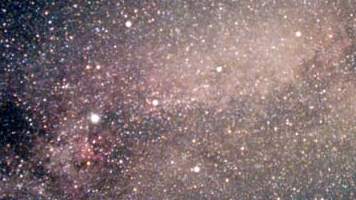
Deneb is Arabic for “the tail” and is the brightest star in the photo of the Cygnus constellation above, forming the tail of a great swan flying southward down the Milky Way. Yet, bright as Deneb is, it is only the third brightest star of the asterism, The Sumer Triangle, at a brilliant white visual magnitude 1.4, or about a magnitude (factor 2.5) dimmer than Vega, and only slightly dimmer than the 1.3 magnitude of The Triangle's third star, Altair.Three stars spread over a hand's width form the wings of the swan, the center, or axis star of which is named Sadr. If you look with binoculars or a small telescope, or in a dark sky, you can see some outlying stars giving the wings a graceful swept-back appearance. The swan has a long neck, with two dimmer stars in the middle and a head or beak formed by the star Alberio, which is actually a beautiful binary pair of topaz yellow and sapphire blue stars of magnitude 3.5 and 7. This is one of the most beautiful sights in the sky, accessible to binoculars or a small telescope.
If you have reasonably dark skies, you will see that the Swan flies along the Milky Way, our view from within of our own galaxy, in which our sun is but one of 100 billion stars. Deneb, Alberio and the three inner wing stars also form an asterism—a grouping or cluster of stars—called, for obvious reasons, The Northern Cross.
Cygnus is home to many cataloged objects, but by far the most interesting object in Cygnus is the first of three x ray-emission sources discovered in the area of the constellation, where, situated halfway down the swan’s neck, lies Cygnus X-1, one of only a few known black holes

Cygnus X-1 is, of course, invisible, since all black holes are so massive and compact that their gravity traps even the photons of light which would carry their image, and its stellar companion, at some 1000 light-years distant, is far too faint to see, but its existence is well established from the eclipsing of x-rays from its accretion disk as it circles its companion in a tight embrace. The orbiting of the companion of roughly known mass gives us the 3-4 solar mass of the density of the object, and the flickering in its output gives the size, approximately nine miles diameter. No object except a black hole can be that small and yet so massive.
A black hole is the final stage in the stellar evolution of a star far more massive than our sun. But black holes are one of the rarest epitomes of death for stars, and Cygnus has been the backdrop for the most spectacular and violent end possible in the life of a star: a supernova.

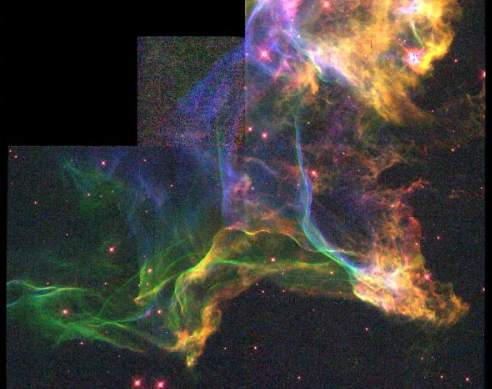

Hubble's Close-up View of the Cygnus Loop
Jeff Hester (Arizona State University) and NASA
This NASA image shows a small portion of a nebula called the "Cygnus Loop." Covering a region of the sky six times the diameter of the full Moon, the Cygnus Loop is actually the expanding blastwave from a stellar cataclysm - a supernova explosion.In this image, the supernova blast wave, which is moving from left to right across the field of view, has recently hit a cloud of denser than average interstellar gas. This collision drives shock waves into the cloud that heats interstellar gas, causing it to glow.
Just as the microscope revolutionized the study of the human body by revealing the workings of cells, the Hubble Space Telescope is offering astronomers an unprecedented look at fine structure within these shock fronts. Astronomers have been performing calculations of what should go on behind shock fronts for about the last 20 years, but detailed observations have not been possible until Hubble.
This image was taken with Hubble's Wide Field and Planetary Camera 2 (WFPC2). The color is produced by composite of three different images. Blue shows emission from "doubly ionized" oxygen atoms (atoms that have had two electrons stripped away) produced by the heat behind the shock front. Red shows light given off by "singly ionized" sulfur atoms (sulfur atoms that are missing a single electron). This sulfur emission arises well behind the shock front, in gas that has had a chance to cool since the passage of the shock. Green shows light emitted by hydrogen atoms. Much of the hydrogen emission comes from an extremely thin zone (only several times the distance between the Sun and Earth) immediately behind the shock front itself. These thin regions appear as sharp, green, filaments in the image.






Text is Copyright © Silkscape Arts - All rights reserved


Web design by
