Medium-format, 35mm, and digital systems all allow the same type of photography to be done of your wedding, from formal and environmental portraits to candids, journalistic and traditional styles, but if you will be ordering enlargements beyond the proof-print size and enlargements you'll receive with your package, you will be especially pleased with the medium-format result. Silkstrand finally put one foot into the digital world with the late 2008 release of a new camera produced by Nikon, the D700, which, along with its sister model, the D3, had the best latitude and low-light capability of any DSLR on the market. In 2016, a pair of Nikon D750 DSLRs replaced the D700, the D750 having twice the resolution with its 24 megapixel FX-CMOS sensor (35mm film sized), its resolution sufficient for 20x24-inch prints, and the D750 pair will now be used for weddings in combination with medium-format film in the ceremony and portrait coverages, as backup. The latest professional digital SLR (single-lens-reflex) cameras have only recently reached just above 36 megapixels in their CMOS sensors, where 25 megapixels matches the best 35mm film for sharpness. The 24.93 megapixel (24.3 effective) D750 is one of the latest Nikon pro-camera bodies, as are the Nikkor lenses used, all designed to deliver the greatest sharpness, latitude (light-to-dark recording ability) and most pleasing color available in digital SLR cameras today.
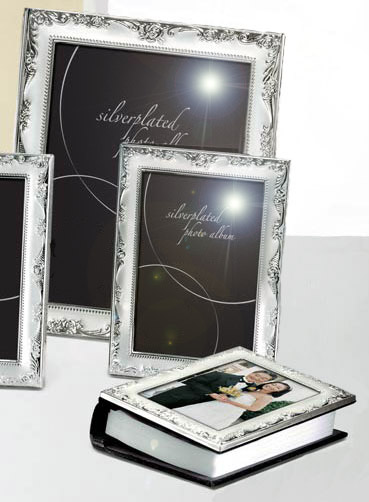
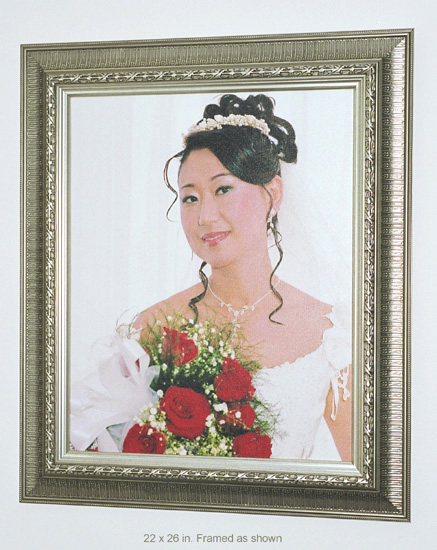
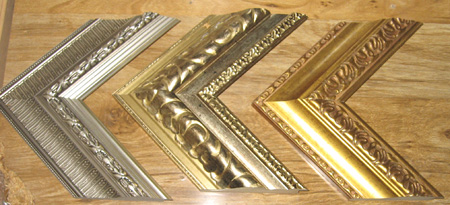
You may have noticed that the package-option standard prints are a larger, 5x7-inch size instead of the 3½x5 or 4x6 size offered by others. There are two reasons for this: first, the 5x7 print is a step up from the drug-store and 1-hour-lab sizes, and you deserve that quality for your wedding. It's large enough to border with a mat and frame and put on a wall, which with only a 1½-inch mat and ½-inch frame (although the mat and frame could be much wider) you have a piece of wall art that's 9x11 inches, and you get three sets, standard, without having to pay extra for enlargements! Or, with a standing frame, you have a really nice picture size that's suitable for desk, credenza, piano, or mantle. And, although the albums you'll get also hold the 5x7s you'll receive, an album is all the others' 3½x5 or 4x6 size is really good for, isn't it? The other reason for 5x7 is that the medium-format equipment and films used to capture your memories justifies the larger base-print size. So think about your wall space when you view your favorite standard-package prints.
Most digital cameras are best for news, sports, catalogs, and family or hobby pictures for prints in drugstore sizes; and with the newer FX-size CMOS, cameras so-equipped are good enough for professional print applications in most fields. Professional digital cameras (DSLR) with FX sensors above 24 megapixels are also suitable for 20x24 prints, and the advantages they offer over film for those fields, are instant gratification and not having to reload film, a film task that is usually very poorly timed with what's happening. And, contrary to the initial thought, saving of film and processing costs (which are all included in the very competitive package prices here) are not an advantage for digital, partly because any change to digital, complete or partial, involves a significant increase in post-event work with managing, editing, and producing the digital images, most of which is not a factor in film production for the photographer, and all of which, in time and equipment, more than offsets any savings over cost of film and processing. Also, most photographers still pay for print processing, whether they do it in-house or through a film or digital lab. The fact is, while the creation of digital images in-camera is easier than film, from a post-event production point of view, time and costs, film is easier and less expensive.
Digital imaging has come a long way, has met 35mm-film quality in the most advanced DSLR cameras, for most applications, and it is still advancing quickly, but digital imaging still hasn't fully met the quality or capability of professional medium-format films and equipment, and film improvement has not been standing still in the wake of digital advances, either. Digital also has operational and safety limitations film does not have. The digital-image memory-storage device is not immune from failure or electro-static damage, and digital cameras are much more complex and fragile than film. If I drop my 645 camera from three feet, to land on a body edge or corner, it will come up still working most times. Do that with my Digital SLR and an expensive repair is all that will make it work again. And the risk of loss of digital images before the photographer gets back to the studio to upload images and make backups (assuming backups are dutifully made) is not even a consideration with film. That's one of the reasons the D750 was selected, because it can image to two separate memory cards at the same time, providing instant back-up for every image captured.
In medium-format film, another advantage comes into play when custom prints are ordered and are cropped, which is where portions of the negative (or digital CMOS) are not used, putting a greater demand on the remaining image area in producing prints or Web images. The large 645 negative makes it possible to isolate and enlarge (crop) smaller sections of an image for use on the Web and in prints that look as good as full-frame 35mm or digital would look if that segment filled the entire negative or frame in those formats. So, if that picture of Aunt Aline in the group shot looks so great that you want to make a cropped portrait of her alone for an enlargement or the Web, the 645 medium-format negative will produce a result with which digital and 35mm film can't quite compete, though the resolution of the D750 does provide some cropping flexibility.
Another disadvantageous factor affecting digital is that because digital imagery does not have the latitude of acceptable exposure that film has (although the digital SLR that will be used in your shoot has come closer than any other, close enough to bring into the mix) the standard procedure is for the digital photographer to try and check each picture taken, on the spot, using a sometimes difficult-to-see LCD screen, which distracts attention from the bride and the events, and the planning and moving for the next shot. Better latitude also means that film, and the digital used by Silkstrand, captures more of the details in the whole range of visible light than most digitals can, from the wedding extremes of the whites of your wedding dress to the blacks of his tuxedo. And, finally (whew!), film cameras do not require the photographer to wait for previously-taken digital images to store into memory before another shot can be fired off, a real problem for a photographer not using the latest, very expensive models of digital cameras, like the D750 selected for Silkstrand weddings, which have solved that problem, and I can't tell you how many times I've taken one shot to then immediately see a different, better expression or posture in the action that causes me to snap another right off—if not using film, or a late-model digital with fast processor and memory card, that's a probable lost shot.
So, in other words, with Silkstrand Wedding Photography, your most important shots will be covered. Within half a decade, digital will have closed all the gaps and even medium-format film will be relegated to special-purpose use, fanatics, and diehards, but for now, and a few years hence, this is a true story, and it's why medium-format film and equipment is part of the resource available for your ceremony and portraits, so that the best choice there is can be yours.










 Mitzvahs